Video Vault
The #1 Mistake People Make When Moving to Vero Beach, Florida
The single biggest mistake buyers make is assuming real estate in Vero Beach works the way it does where they came from. It does not, and the assumption is expensive.
Key points
- Vero's market does not behave like the market you are moving from
- Hundreds of relocations inform the pattern behind the mistake
- Recognising the difference early is what protects the decision
Full transcript
What Sally covers, in her own words.
Transcribed from the video and lightly corrected for readability.
Every year, hundreds of people move to Vero Beach, Florida, chasing their slice of paradise, whether it's days on the beach, country club lifestyle, whatever it is. But a lot of people get it wrong. What they assume is real estate where they are works like real estate in Vero Beach. And it does not. I'm Sally Daley. I've helped hundreds of clients find their slice of paradise here in Vero Beach, Florida, and helped all of them avoid an expensive mistake. I'm going to break down top mistakes not to make so you avoid them.
Most people come with the mistaken notion that Vero Beach is one market. Wrong. We are a collective of micro markets and you do yourself well by understanding that. What do I mean by that? Well, we are a barrier island with fixed bridges and a vibrant mainland. That in of itself makes a material difference. Land values on the barrier island, well, they're not making any more land on the island. Last time I checked, land values on the barrier island are dramatically higher than land values on the mainland. That fact in and of itself makes prices more expensive on the barrier island, which is understandable.
Even within the barrier island, you've got a dividing line with A1A that goes north to south. Land east and west is valued differently. East of A1A as well. If you want to get to the beach, you don't have to cross over A1A. That in and of itself makes east and west properties, even if they were exactly the same, different values. Roughly 10% difference in price to pay to be east of A1A and not have to cross over. But let's even talk about that. Even that depends on where you are. If you're along the southern part of the barrier island where there are fewer communities and less traffic versus the communities that are right before the first bridge, which is our 17th Street Bridge, all of the traffic has to go north to that bridge, right?
So, if you're west of A1A in one of those communities, you're going to have way more traffic getting to you than if you're on the southern end of the island. Even though there's no traffic lights or maybe one traffic light, it's going to be materially quieter and less busy. So, even within subsections of the barrier island, land location makes a difference. And of course, within the island, there are different quadrants. The southern end of the barrier island is more traditional, larger lot houses. Most folks take care of their own properties.
If there's an association, it's going to be say for a gated entry or a private beach. The middle part of the barrier island is going to be largely older condos, our central beach area and our Old Riomar area and our Riomar Bay where there are some of the toniest communities, most expensive real estate we have where everybody wants to be cuz it's close to get to everything. In that part of town, you can buy a golf cart and you can walk and bike to everything. Central Beach, Old Riomar, no HOA.
Very different than the southern end of the island that typically is dominated by HOA run communities. Northern part of the barrier island has a very large golf course community, country club community, a beautiful community known as John's Island. After John's Island, the majority of the northern part of the barrier island, you have communities where many of them are what we call a zero lot line community, which is kind of, think about it as an alternative to a generation saying, "I don't really know if I want a condo with a neighbor over my head." Many people do, but a lot of people do not.
So, the zero lot line is a house fully detached on a smaller, decidedly smaller piece of land, but guess what? It offers condo- like convenience. They'll take care of your yard work. There might be a community pool or a marina, etc. So, that is a mashup of single family ownership with condo- like convenience. How different is that? And that's just the barrier island. When you got on the mainland, there's even more diversity. There's old original neighborhoods like MCant Park. It all matters and you need to know the nuance differences in order to make an educated decision about what is the right lifestyle for you.
So, now we're going to get real and talk about an issue that's really happening not just in Vero Beach, all over Florida. Frankly, Miami, Palm Beach, it's a thing. Country Club availability. If you are a buyer that's coming to town and a club is important to you, you need to understand the waiting lists are really a thing. But let's back up a little bit and talk about broadly the whole notion of a club. There are two models for a club. One is where there is real estate a golf club or whatever the club is and you buy in that neighborhood and you may only join the club if you live within that specific community.
Meaning you can hop on your golf cart and get to your golf game. We have some clubs like that. We have John's Island. We have Orchid Golf. Windsor are like that. You may not join any of those clubs unless you own real estate within that community. Is that a good thing? Well, it's not guaranteed at John's Island and it's not guaranteed at Windsor. Orchid, you must join and be accepted before you even close. So, it is a guarantee there and it doesn't mean you run the risk of having a house without a club membership.
But in Windsor and John's Island, you could buy a property and they could deny you. Now, a judicious broker like myself would have connections and could help you make those inquiries and and minimize that risk, but just know there's no guarantee. Nor can you offer contingent upon a club membership because that's going to be a hard no. So, that's one model. The other model is where the club is untethered from the real estate in Vero Beach. Clubs like the Moorings, Grand Harbor, Bent Pine, Vero Beach Country Club, Quail Valley, all are a club in and of themselves.
You can live wherever you wish. There's pros and cons to both. Now, you can't hop on your golf cart and get to any of these clubs, but you will have people from all over Vero Beach. You're not going to see necessarily just the same community members all the time. There's pluses and minuses to both. That said, clubs like the Moorings and Quail Valley and Vero Country Club have waiting lists and they are not insignificant. Right now the moorings is around a year and a half for full golf. Quail Valley is you sitting down 6 years social 10 years full golf.
That's a long time. Vero Beach Country Club about a year. Our advice is always if you know there's a specific club that you want to join, get on the waiting list before you even get into contract to purchase a house. It's a super important step to make and there are options for you as your wait list percolates along and you get closer to getting your membership. many nice clubs that I just mentioned, whether it's Grand Harbor, that is a beautiful beach club, by the way, that just got renovated. It's lovely.
Shout out to them. Indian River Club, Bent Pine, they all have availability. And it doesn't have to be your forever club, but a lot of people do that and then like it so well they keep the membership even when their preferred membership opens up at their club of choice. That's the first thing. The second thing is there are ways around accelerating that waiting list. What do I mean by that? There are properties that clubs will permit you to buy the membership, so to speak, but you don't really buy the membership.
For example, Grand Harbor will allow this. I know that the moorings will, too. There are properties for sale from a $600,000 condo that comes with its own dock cuz it's on a deep water canal to lovely oceanfront condos where the owners wish to get their equity back and rescend their memberships. So, what does that really mean for you as a buyer? If you bought that property, as long as you wanted to buy the same kind of membership they had, it allows that member to go to the top of the list to get their equity back and you basically get to jump the line.
And so your membership wouldn't necessarily be purchased from that membership, but what would happen is at closing, you would show proof that you've made application for the same kind of membership they have. You go in together with the owner, you close, you get to jump the line, they get their equity back, problem solved. It's really becoming a bit of a thing. And some buyers that have the resources to do so are literally buying these properties with no intention of using them. As soon as they close, they get their membership and they either put it right back on the market or they use it as a rental property.
or some buyers that have the discretionary dollars to do this. Let's say you're buying a property on the river like my beautiful listing at 1915 Cutless Cove. If you had a Jones for a membership for the Moorings Club, which is literally walkable from this property, well, this is on the river. What a beautiful portfolio of property you would have if you bought a condominium on the ocean that had a membership. Well, wouldn't that be great? you would have overflow for guests or you wanted to spend the weekend on the beach.
There it is. Your condo's right across the street on the ocean and simultaneously, hooray, you get a way to jump the line and you get to join the Moorings Club faster and you avoid the wait list. But it's something to consider. Talk to your trusted real estate advisor. It's not just Vero. It's everywhere. It's really a thing. If it's important to you, make sure you're having that conversation with your trusted real estate advisor or DM me. We can talk about it and I can give you options that might work for you.
Cautionary tale number two, mainland v barrier island. You need to understand the dynamics of the barrier island. An island fixed in its size, fixed in its buildout versus the mainland. While even though we have density and height restrictions, we still have more actual land to build houses, more housing product on the mainland. That gives you as a buyer more options, but it also means that prices are more affordable on the mainland versus the barrier island. What's important to you? If you had a budget of 5 cents, it's going to buy you a lot less on the barrier island than it would on the mainland.
So that comes down to what's your priority? Is it proximity? Is it important for you to walk to the beach and bike to the beach? Do you understand that all of the beaches are free of charge and no fee and that there's nothing that's not within 15 minute drive because we're low density and we don't have a lot of congestion? So, what are your priorities? Understanding that will help you understand whether you want to look on the island or the mainland. Now, I will also say because there's more housing stock on the mainland with some new construction, you're going to be able to maybe get a a a better deal.
Listtoell prices are a little tighter on the barrier island because there's less inventory. And even if you do through seller circumstance get a better deal, the base you're buying is going to be higher. So even if you get a better discount is still going to be on a bigger base number. Prioritize what is important to me. One of the first things I will say to a client when they're thinking about it is what is important to you, condition versus walkability to the beach. That's a really important one to consider. Cautionary tale number three, hidden costs that you really need to understand.
What am I talking about? Insurance and how old is my roof? Well known with publication and headlines all over, you know, the United States about the costs of ownership in Florida have gone up since co. Well, cost of insurance have gone up, too. A bunch of underwriters pulled out. Luckily, we've got about eight new underwriters that have come to town that are willing to write. For goodness sakes, when you're working with me, I'll always make sure you have this information. Talk to your trusted advisor. Talk to your trusted insurance broker.
You need to find out two really important things that really affect the cost of acquisition and cost of living in Florida in Vero Beach. One, how old is your roof? If your roof on the house you're looking at is more than 15 years old, even if it's leakfree, it could be very tough to insure. And if you can't insure it, that means you have to be a cash buyer. Most people want and need a mortgage, myself included. So even if you're cash and you want to take a more take no insurance, you want to self-insure, you want to make sure that roof is going to stand up to the rigors of the coastal living here in Florida.
So find out ahead of time the age of your roof and how much life is left on it and get a quote for a new policy for insurance because if it's expensive to ensure it could mean you say I didn't think it was going to be that much money. I don't know if I want this house and or maybe I want the house but I'm going to pursue it with a different top end cuz that part of my monthly not is higher than I expected it to be. Number two, building codes.
What's the What year was your house built in? Quick primmer. Building codes in Florida are always changing to keep cool AC in, wind and rain and storm damage out. It's important to understand in 1990 our county adopted the Miami day build code, which is a very good thing. That means my house is a 1990 house. It was built in a stronger way than if that same house was built in a different county, say Orange County. In 2000, the entire state adopted the Miami Dade build code, but it changes all the time.
The amount of wind that your glass can take, whether it's your doors or your windows, changed from 140 to 160 mph, 04 and 06. In 2012, the codes for your roof, literally what keeps your roof attached, changed. In the 20 years we've been here, it's changed bit by bit. The nails get longer, the pattern gets tighter. Instead of having your straps clipped, they need to be nailed down. Now, new construction even requires a collar beam going all the way down and threading rebar down to your block base. That sucker is going nowhere.
So, it's super important for you to understand your code. And if you're fortunate enough to be looking at a home that is near water, whether it's the river or the ocean, it's really important for you to understand literally what lies underneath. House I'm in right now. 1915 Cutless Cove. 450 grand below grade that you can't even see with grade beams, rebar pilings. This this house is going nowhere because our soils are relatively sandy. And when you build, you're going to be required to do what's called soil samples. And that's going to be kind of your road map as to what you need to build.
And if the soils are not super stable, as is super common as you get near the water, you're going to have to do a structural slab and/or pilings like this house did. So, if you're looking at a house like pre 2004, like 1990s, I have seen houses on the river where clients will say, "Sally, what's the deal with this crack in my pool? It keeps getting wider and wider." Well, the pool's not on pilings either, as it would be now, and that sucker is getting coughed up by unstable soils, and there's no fixing it.
You literally have to rip it out and do it. Or if you're looking at a house from 1990. One time I had a client looking at a house from 1990. And he said, "I'd like to add square footage to this house." And I said, "Jim, this is on a monolithic slab. This is not even on helical piles. I don't know literally that an engineer would say the house could sustain that weight." So literally, it behooves you to work with somebody. Call me. I'll help you figure it out. understand literally what was the code like when that house was built.
So you understand and that's just the code. Let's talk about elevation. How far off at base sea level is it? We have some older communities that are fabulous but boy those houses are low and if they were renovated it's probably because at some point they may have had some flooding. Most of our barrier island has a ridge that's naturally much higher than other parts of South Florida. Parts of Miami, we all know, have to have very intricate, very convoluted and complicated ways to keep water out cuz they're so low. We're fortunate that our base elevation is naturally higher, but as build codes changed, not only would they say, "Okay, S, you can build, but you need to not only do you need to now have this kind of slab and this kind of roof, we want your base elevation to be higher." So, broadly, anything 1990 and newer is going to be at a higher elevation.
We have some lovely older communities that are on the ocean and I am not joshing. If it's a singlestory, you're looking at sea grapes. You can hear the ocean. You are not looking at it. And if it's a twostory, you're probably only going to have views from the upstairs. So, it's super important for you to understand these nuances. And if you don't, if you buy an older house and you think your pool is fine and you're just going to do a little fix up and it's not on pilings, you could be in for a rude awakening.
Or you buy a house that's on a monolithic slab and the stables are on soil and you want to add square footage. You may get a expensive bill from an engineer saying you can't do it or you can but you're going to have to add serious infrastructure like helical piles that really add a lot to your rena. So understand what you're working with before you commit to the house. One of the very first questions is vital for you to think about HOA. No HOA. Now at first blush you're going to go no HOA Sally don't tell me how to live.
Don't tell me what to do. I'm going to break it down to you very simply. Okay, you don't want an HOA. Would it make you crazy if your next door neighbor kept a boat or an RV in the front yard? If you say yes, 100% that would make me crazy, you need to scratch a non-HOA cuz you're not going to be able to do a darn thing about it. And it's permissible. So, think about how you like to live. And what I would say is no HOA is terrific. If you look around and you see a super consistency amongst your houses like Old Riomar in the middle of our barrier island is a nonhoa community.
Riomar Bay across the street, the sister community right by Quail Valley Club. All deep water, sensational. Those are arguably our two most desirable communities in Vero Beach. Neither of them have an HOA, but they're kind of outliers. I would say what you need to keep in mind is if there's no HOA, you can't control what your neighbor does. And if that's going to make you crazy, scratch it and get an HOA. But how do you know HOA to HOA? They're all different. It's important that you understand the HOAs and literally take a look at the rules and regulations before you fall in love with a house.
What if you look at the rules and you say, "This is crazy. I mean, I want to be able to rent my house, you know, twice a year and no rentals are permitted in this community or I don't know if I can live with them having to look at everything I do in my life for the front of the house. I want to be able to do my thing. If that's going to make you crazy, then you need to think about whether or not that's the right community for you because there were rules and there were rules.
We live in a gated community called Sean Point. And for us, we wanted the bare minimum. The whole point of an HOA, right, is to say we want to make sure the community is maintained in a way that is harmonious and it supports everybody's property values. That's fantastic. And have architectural guidelines so you're not living next to a quite hut, but not so severe that it looks like the Steepford wives. Nobody wants to live cookie cutter. But within HOAs, talk to somebody like me who understands the lay of the land, which HOAs are known to be a little more particular and make sure you can take a look at those rules and rags before you commit to falling in love with the house.
Nothing would be more of a bummer than falling in love with the house. And you have to have it. And then you go, "Let me take a look at those HOAs." And then you say, "Oh my goodness, there's one that she'll go nameless." Literally, you're not allowed to turn on your motorcycle. You can have one, you can't turn it on. You have to back it out to the main entry. Isn't that silly? First of all, how do you enforce it? Another one would be pets. Do they have restrictions on the pets?
Well, my dog is 45 lbs and the limit is 40. What are they going to do? Put a scale there and measure it? Still, who wants to enter a community worried about such matters? So it's super super important initially HOA no HOA and even within an HOA what are the rules and regs and all of that is public record and your trusted real estate advisor or I can help you see that and it's typically under a section called usage restrictions and at a minimum they may say what kind of roof material is allowed.
Some of them like my neighborhood you're not allowed to do metal roofs. So, if that's important to you, that's not the right neighborhood for you, then drill down to things like renting. Well, if I'm not here, can I rent it for 3 months? If that's a hard no, you may not want to pursue that community. So, it's important that even if you say, I'm okay with HOAs, that you take a hard look at what those rules really are and are you okay with them, and can you live with them? If not, scratch the community and don't fall in love with the house cuz that's going to be a total bummer.
So, bottom line, don't be like people that come to Vero Beach and think it's all the same. It's not. Understand the differences between the island, the mainland, what that does for prices, accessibility to the beach, walkability versus not. HOAs versus not HOAs, can you deal with them at all or not? and understanding within each HOA what those rules are, age of your roof, cost of insurance, understanding what it's really like to live here and what it's like to pay for that every single month and make sure it's affordable and the country club scene understand what that is if it's important to you.
DM me and we can figure it out together cuz I've got 22 years worth of experience and intel to be your secret weapon to finding your slice of paradise in Vero Beach, board.
Keep watching
More from the Video Vault.
 13:36
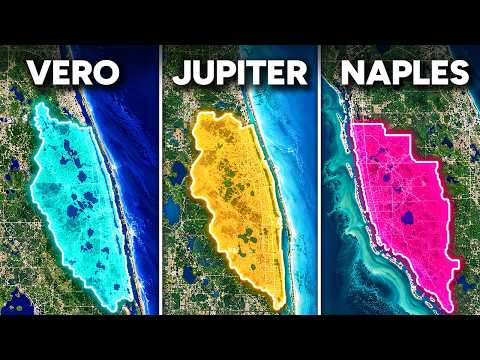
13:36The Difference Between Living in Vero vs. Jupiter vs. Naples
Three Florida towns that buyers treat as interchangeable, priced against each other. Sally puts the same million dollars, and then two million, against a real property in each of Vero Beach, Jupiter and Naples, including what the monthly maintenance actually costs and how far the beach really is. Prices, ages and market conditions are as she gave them in September 2026.
 13:29
13:29Why So Many People Moving to East Coast Florida Choose Vero Beach
Why buyers who start out looking at Boca, Palm Beach and Miami are quietly landing in Vero Beach instead. Sally names the three drivers (congestion, water and golf, and bang for your buck) and is straight about the one real friction, which is getting here by air. Prices, club availability and flight routes are as she gave them in September 2026.
 15:04
15:04Comparing Where To Live on Florida’s East Coast
A quadrant-by-quadrant read of Florida’s east coast (North Florida, the Space Coast, the Treasure Coast and South Florida) and what the same budget actually buys in each. Sally puts numbers on every band, explains why Vero prices differently from its neighbours, and ends on the ownership costs that decide whether a house is affordable at all. Prices are as she gave them in September 2026.
Questions the video didn't answer?
A private consultation gives you the same market intelligence, applied directly to your decision.