Video Vault
Comparing Where To Live on Florida’s East Coast
A quadrant-by-quadrant read of Florida’s east coast (North Florida, the Space Coast, the Treasure Coast and South Florida) and what the same budget actually buys in each. Sally puts numbers on every band, explains why Vero prices differently from its neighbours, and ends on the ownership costs that decide whether a house is affordable at all. Prices are as she gave them in September 2026.
Key points
- The same money buys a very different house per quadrant: six to seven hundred thousand for a new build west of Jacksonville, 400s to 700s around Daytona and Palm Bay, 450 to 550 in the Port St. Lucie master-planned communities, and 2 to 20 million for a new build on the Vero barrier island
- Vero’s scarcity is policy, not accident. Indian River County has run a low-density, limited-supply mandate since 1977, which is the structural reason it prices apart from Sebastian, Palm Bay and Port St. Lucie
- Insurability is a function of flood zone, roof age, distance to water and impact glass, so check all four before falling for a house, because the monthly cost of owning it may move what you can afford to offer
Full transcript
What Sally covers, in her own words.
Transcribed from the video and lightly corrected for readability.
The same budget buys a teardown in one part of Florida and a brand new house in another. I'm Sally Daley from The Daley Group at Douglas Elliman, and today I'm going to discuss the different sections of Florida, how they play out, how they live, so you can try to figure out which one might be right for you. So let's dive right into it.
Broadly, if you're looking at the east coast of Florida, it goes all the way from Jacksonville down to Miami. That's a lot of real estate to try to figure out. For today's discussion, I'm going to define North Florida as Daytona, up north of NASA where Cape Canaveral is, through Jacksonville. Central Florida I'm loosely defining as Melbourne, the Space Coast where SpaceX is and NASA, Vero Beach, Port St. Lucie, Stuart, Palm City. It's an important quadrant. South Florida I really think begins with Jupiter, Juno, Boca Raton, Delray, Palm Beach, all the way down to Miami. So broadly, those are the quadrants. They live differently, and you get a different buy box for the same amount of money in each of those.
Jacksonville and North Florida broadly along the coast is going to be the most affordable. Why is that? Well, it's a jobs-based economy. There's a lot of manufacturing and business and enterprise there. And they've got land west of the river. There's a lot of new builds going on, and young families coming to town who live and work there and need more affordable housing love that part of town. So you can get a new build for six or seven hundred thousand.
Hop onto the island. Location, location. You're going to have Amelia Island, Fernandina Beach. Those are going to skew to an older buyer, probably, and it's a more luxury price point because you're on an island. So condominiums, single family homes, estates are going to be anywhere from 1.5 to 10 million broadly. And in general it's going to have a younger vibe because of the industry that is there.
As you go south, you'll hit communities like Palm Bay and Daytona. They're going to skew a little bit older, but they're also going to have more options, because the zoning density mandate permits development in density. So you've got new builds in communities like Palm Bay where a buyer will have a little more leverage: there's more land, there are more new communities, and it's a dynamic community that's happening, but it's going to skew older.
So let's talk about the Space Coast. The Space Coast is now home to all kinds of related industries: SpaceX, Harris. There's a lot of enterprise going on there. So what has that done? Well, it's brought younger people in, because of high-paying jobs. People are relocating, they want the high-paying jobs, and they're demanding housing that suits them. So there is housing there on the mainland, as well as a barrier island that has many different submarkets on the Atlantic, all kinds of micro-mini communities. You have Merritt Island, some really interesting spots that are frankly going to be more affordable than Vero Beach or South Florida.
So let's talk about south of Melbourne. South of Melbourne, where the tropics begin, I would really say is more the middle of Florida. That would be Sebastian, Vero Beach, Port St. Lucie, and then down into Stuart and Palm City. Those are both in Martin County. I think that's a good chunk to delineate because it acts differently. It's going to be more affordable than South Florida. You're going to be within the tropics.
Vero is going to be the most supply constrained, and Sebastian as well, because that's Indian River County. We've had a low density, limited supply mandate for policy and development since 1977. So it affects supply. That said, it's darling. It's a barrier island community. It feels like a small town. It lives like a small town. There are no six-lane highways. You can actually get to the beach, it's free of charge, it's quite charming. We have called it home for 24 years now and would never think of living any place else.
South of us is Port St. Lucie and Fort Pierce. Much more development is available there, which means prices are lower because there's more supply. Has a burgeoning downtown, a beautiful farmers market. Stuart and Palm City I've talked about before, and I'm extremely bullish on Stuart. Everything from Jensen Beach, which is their community on the beach, to Sewall's Point, which I love, very old Florida vibe, down to Stuart just across the river where my daughter lives very happily. It's really a thing, and you get more bang for your buck. Port St. Lucie has a combination of condos and enormous master-planned communities out by the Turnpike and I-95 in Tradition, that is growing, growing, growing and really is becoming its own community and its own neighborhood. So there are a lot of different directions to go if you want to be south of Vero, and you don't want to be north, and you want to be outside of the tropics.
South of Stuart you have Juno Beach, Jupiter, West Palm Beach, Palm Beach, Fort Lauderdale, Miami, Boca Raton, Delray, and the numbers start to get very, very spendy. But you're getting an incredible lifestyle, and you're also getting more density. So it depends what's interesting to you. So broadly, that's how I would categorize the quadrants of the state of Florida.
Daytona, Melbourne, Palm Bay: 400s, 600s, 700s, healthy budget. You'll probably like what you can get. Vero is going to be, you know, the lovely house where I am right now is 685. It's killer. It's on the lake. It's an amenitized community. It's only a year old. Shout out to the Preserve at Waterway Village. This is on White Alder. Call me if you want to see it. It feels like a new house.
The difference about Vero compared to other parts of Florida is density, density, density. I hate to beat that dead horse, but we've talked about it multiple times. It drives everything. On the island, new builds are going to be, you know, 2 million to 20 million depending what you're buying. And an older home that's had renovation could be a million five to two five, broadly.
If you want to spend less than that, you say, Sally, give me something under a million. I've got a great house on Oyster Bay. Shout out to Oyster Bay at 949. It's a killer value. It's got a very deep, 150 wide lot. Plenty of room for a pool if you wish. Concrete block, impact glass. Dreamy beach that you can walk to. The community's private beach access is only a seven minute walk, is fabulous. [Recorded before the price change: 2130 Oyster Bay Drive is now $850,000.]
Generally speaking, if you wanted newer like that one, broadly you would go to the northern end of the barrier island in Vero, and you would sacrifice location, because you'd be on the northern end of the barrier island instead of more in town, and mostly lot size, because it's going to be what we call a zero lot line community or a villa, where you have a more diminutive piece of land, maybe 50, 60 wide by, you know, 100, 120 deep. But then you probably also have an association that takes care of your yard, your irrigation, and you probably have a community clubhouse with fitness, pool, et cetera. So it is possible in Vero Beach.
Now, if you go south, Port St. Lucie, we talked about some of the master-planned communities out by Tradition: 450, 550. Again, lot size is going to be more diminutive, and you're going to be out more towards I-95. So location and lot size will be a concession there too. And once you hop over beyond that, Juno, Jupiter. Gosh, country club communities like The Bear's Club, 32 million, and you're not on the water, you're on the lake. Admiral's Cove, very well regarded, well established, yachting community. These are all beautiful communities. We've talked about this before. The density that's there causes more of a development model where it's club to club to club to club. So it's going to be a much more expensive proposition.
But if you want a vibrant lifestyle, gosh, West Palm is having a moment. Clematis and all the redevelopment down at City Place, new builds going up on the river. There are all kinds of interesting and dynamic things going on. It's becoming known as the Wall Street of the South. There's industry going in, so it's no longer just a yacht club and tourism industry. And Miami is a vibe all of its own, but it's a very different buy box in terms of what you can get. It just depends what you want.
So let's talk about culture and pace of life, how they all live and feel. Vero is going to be quieter: Hamptons of Florida, small town vibe. Stuart is definitely going to be busier, has more of a yachting vibe. And then Fort Lauderdale, Jupiter: very vibrant, very busy, very congested, starting to push people away, frankly. It's got a great vibe, but there's no short way to get anywhere because there's a lot of traffic. And places like Boca and Palm Beach still have drawbridges. Then of course there's Miami. That's an urban vibe. Delray is kind of the best of both worlds, but it's not inexpensive. So it just depends what you're interested in.
In terms of transportation, Vero probably has the most friction, although we have less than we used to. We don't have a major airport. We're equidistant to Palm Beach Airport and Orlando, but if you're coming from the Midwest or from the West, you may find it a little difficult to get to Vero. So that does have a bit of an effect on the number of people that are coming here, but it's a lot easier than it used to be. Obviously, as you go north, Jacksonville has a beautiful airport that's easy peasy. Melbourne has its own airport. Fort Lauderdale obviously has its own airport. Miami obviously has its own airport. So in terms of traffic and friction, that's kind of the way it lays out.
Healthcare is pretty good everywhere. We've got the Cleveland Clinic here in Vero. Obviously you've got Mayo and beautiful facilities up in Jacksonville. Miami very well regarded. Palm Beach also well regarded. So it's less of an issue than it used to be, in general.
So insurance, cost of living. Really, no matter where you are, it's going to be a function of: are you in a flood zone or are you not in a flood zone? What's the age of your house? How old is your roof? How close are you to the water? And do you have protection for your glass against horizontal rain and debris? All of those things will make a material difference, so always do your due diligence on that score. Parts of Miami and parts of Fort Lauderdale have low base elevation and it's more of a thing. Vero is blessed to have a naturally higher elevation along our ridge line, and I believe that's also the case up in Melbourne. I can't say that definitively. But those are all matters that you need to check before you fall in love with the house. Make sure it's insurable and you can afford it. If it's more expensive than you realize, you might want to consider your approach to the house, and maybe not offer as much, and maybe your top end comes down a little bit, because it's not just about the cost of buying the house. It's the cost of owning it every month, as we all know.
So in a nutshell, if I needed to paint an avatar or a picture of who lives in all these places: Jacksonville is somebody that doesn't particularly care about old man winter. They want a jobs-based economy, maybe they want a job there. They like the idea of getting to Georgia and other parts of the southeast with ease, yet they also appreciate there's a river for activities, as well as Amelia and Fernandina Beach. So it's probably going to be a slightly younger buyer, frankly. There's also a shout out to St. Augustine. I haven't mentioned that. St. Augustine is a very interesting community, historic and super fun. So I apologize, St. Augustinians, I didn't mention you before.
Daytona through Palm Bay is probably going to be an older buyer who is price sensitive and wants affordability, and likes the idea of new and very little maintenance. Vero and Sebastian generally is somebody who is a lover of conservation. The Hamptons of Florida. Likes a quiet small town vibe. Doesn't necessarily have to have a Trader Joe's or Whole Foods in their backyard. They care more about conservation, quality of life, no high-rises. The small town vibe speaks to them. Privacy is a thing, they care about it.
Stuart: if you're a boater, Stuart is a place you really need to check out. Places like Sailfish Point offer unparalleled access, and there are all kinds of places to take deep water boats out. It's a beautiful, beautiful community, internationally known, rightly so. Juno and Jupiter: you want Palm Beach adjacent, but you don't necessarily need that hub right there, and it's a little bit more affordable, although getting less so. Jupiter, if you're a golfer, man, you've got to check out Jupiter. I think every PGA and LPGA person is associated with the club there. The golfing's really good, the clubs are unbelievably beautiful. But you need to understand that with that density, most buyers say they spend most of their time within their community, which becomes their hub, because to go out you get six lanes everywhere, it's crowded, and it is a thing.
Fort Lauderdale, of course, internationally known for boating, deep water, and it's becoming almost Miami adjacent, and an alternative for people that are saying Miami is becoming too much, too expensive, too crowded. And then you go into Miami, you get Aventura, Coconut Grove, super well regarded, beautiful high-rises, and then you have all the islands that are lifestyles of the rich and famous.
So in a nutshell, that's how I would describe how the coast of Florida shakes out. I've got trusted advisors in all of these towns who operate the way I do, with integrity and caring about your outcome. We all just want you to find the right house in the right neighborhood. We don't want you to be in the wrong house in the right neighborhood, or in the right house in the wrong neighborhood. We want the fit that you're going to love and be in long term. I'm Sally Daley from The Daley Group. If this is helpful, and I hope so, call me, DM me. hello@thedaleygroup.com is my email. I'd be delighted to help you suss this out further and continue the conversation.
Keep watching
More from the Video Vault.
 9:36
9:36Why We Left EVERYTHING And Moved To Vero Beach, Florida
Sally’s own relocation story: a Connecticut consultancy, a ten-year search that ran through Charleston, Wilmington and Boca, and a school on a barrier island that decided it. She ends with what Vero actually costs, on the island and off it, and why she went into brokerage in the first place.
 14:35
14:35Do Not Retire in East Coast Florida... Without Knowing This
Florida's east coast is not one market. Sally breaks it into five distinct regions, each with its own price ceiling, pace and buyer profile, so retirees choose a region deliberately instead of assuming the coast is interchangeable.
 13:36
13:36The Difference Between Living in Vero vs. Jupiter vs. Naples
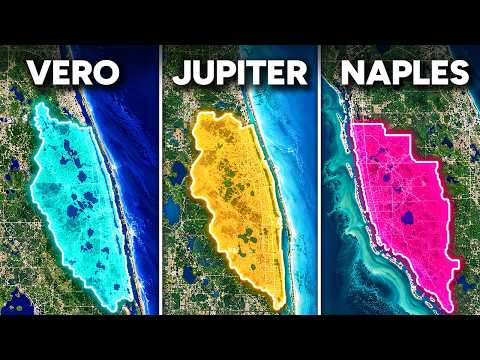
Three Florida towns that buyers treat as interchangeable, priced against each other. Sally puts the same million dollars, and then two million, against a real property in each of Vero Beach, Jupiter and Naples, including what the monthly maintenance actually costs and how far the beach really is. Prices, ages and market conditions are as she gave them in September 2026.
Questions the video didn't answer?
A private consultation gives you the same market intelligence, applied directly to your decision.